
Gumloop Review 2026: Features, Pricing, Pros & Cons, and Real-World Applications
Gumloop is an AI-native automation platform designed for building intelligent workflows without coding. Unlike traditional automation tools that simply connect apps together, Gumloop places AI at the center of workflow logic, enabling users to create systems that can reason, classify, summarize, scrape, and automate complex business processes. It has quickly gained attention among startups, marketers, operations teams, and AI-focused businesses looking for more advanced automation than platforms like Zapier or Make.com typically offer.
Key Features
AI-Native Workflow Builder
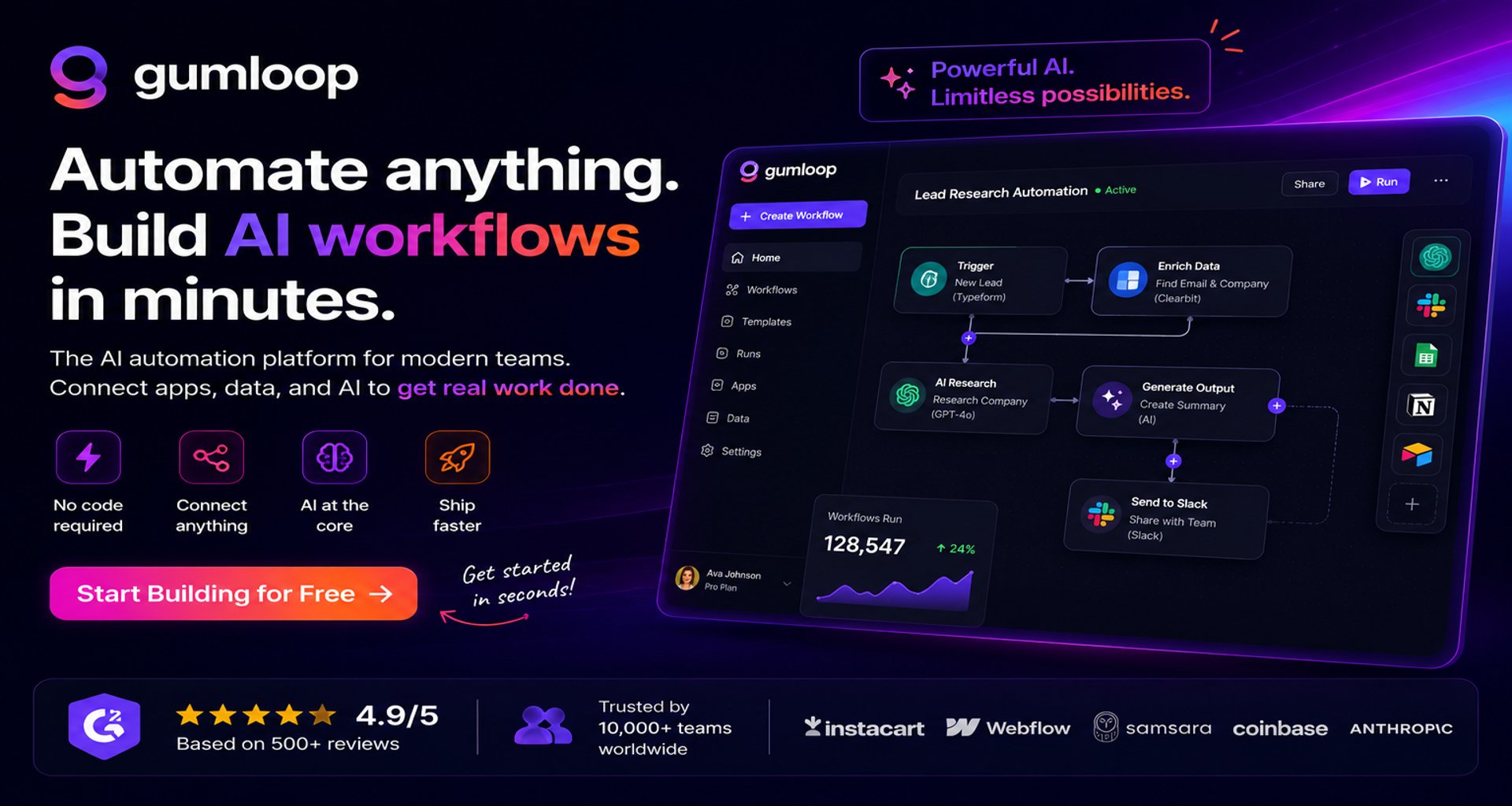
Gumloop uses a visual node-based editor where AI is deeply integrated into every step of the automation process. Instead of adding AI as a simple action, workflows can use AI for reasoning, decision-making, classification, summarization, and data transformation.
Drag-and-Drop Automation Canvas
The platform provides a no-code workflow builder that allows users to create complex automations visually using connected nodes, triggers, and actions. Many users compare the experience to combining Zapier with AI agents.
AI Agents and Intelligent Flows
Gumloop supports AI-driven automations capable of:
Web scraping
Document analysis
Data enrichment
SEO automation
Lead qualification
Content generation
Research workflows
These workflows can adapt dynamically based on AI-generated outputs.
Large Integration Ecosystem
The platform supports integrations with tools such as:
Google Sheets
Slack
Notion
OpenAI
Anthropic
Semrush
Gmail
Webhooks and APIs
Users can connect AI systems with business applications without needing custom code.
Gummie AI Assistant
One of Gumloop’s standout features is “Gummie,” an AI assistant that helps users generate workflows automatically using natural language prompts.
Parallel Workflow Execution
Gumloop can run multiple automation processes simultaneously, which makes it suitable for high-volume data processing and AI operations.
Subflows and Modular Automation
Users can create reusable workflow components (“subflows”) to simplify large automation systems and reduce repetitive setup work.
Who Is It Best For?
Gumloop is best suited for users who need AI-heavy workflow automation rather than simple app-to-app task automation.
Ideal Users
Marketing teams automating SEO, content, and lead generation
Operations teams managing repetitive AI workflows
Startups building AI-powered internal systems
Agencies handling research and automation at scale
Non-technical founders wanting advanced AI automation without developers
AI-focused businesses working with structured and unstructured data
Less Suitable For
Gumloop may not be ideal for:
Beginners looking for extremely simple automations
Teams needing enterprise-grade governance and mature admin tooling
Businesses only requiring basic triggers and notifications
Users uncomfortable with workflow logic and AI configuration
Many reviewers note that Gumloop has a steeper learning curve than Zapier because of its flexibility and AI-centric design.
Benefits
1. AI-Centered Automation
Gumloop’s biggest advantage is that AI is integrated directly into workflow logic instead of being treated as an add-on feature. This enables far more intelligent automations.
2. Saves Significant Time
Users frequently report saving several hours per week by automating repetitive research, SEO, outreach, and content tasks.
3. No-Code Accessibility
Despite its advanced capabilities, Gumloop remains accessible to non-developers through its visual builder and AI-generated workflows.
4. Strong for Complex Workflows
Gumloop performs especially well for multi-step AI pipelines involving scraping, summarization, enrichment, and decision-making.
5. Built for AI Scale
The platform supports high-volume AI workflows with concurrent processing and reusable modular logic.
6. Integrated AI Models
Some plans include built-in access to premium AI models without requiring users to manage separate API keys.
Real-World Applications
SEO Automation
Users automate:
Competitor analysis
Content audits
Internal linking suggestions
Keyword research
SEO reporting
Lead Generation & Sales
Gumloop can scrape lead data, enrich contact information, qualify prospects, and generate personalized outreach emails automatically.
Content Repurposing
Marketing teams use Gumloop to transform videos into blog posts, create social media calendars, and generate content summaries.
Research Automation
The platform excels at web research workflows that collect, summarize, classify, and organize online information using AI agents.
Document Processing
Businesses use Gumloop to analyze PDFs, extract structured data, and automate document-heavy processes.
Customer Operations
Teams automate support ticket classification, routing, summarization, and response drafting using AI-driven workflows.
Pros & Cons
Pros
AI-First Architecture
Unlike traditional automation platforms, Gumloop is built specifically for AI-powered workflows.
Powerful Visual Builder
The drag-and-drop workflow editor makes advanced automation possible without coding.
Excellent for Complex AI Pipelines
Gumloop handles workflows involving scraping, reasoning, summarization, and enrichment particularly well.
Strong Productivity Gains
Users commonly report major time savings and operational efficiency improvements.
Growing AI Ecosystem
Features like Gummie, guMCP, and Gumstack show that the platform is evolving rapidly beyond basic automation.
Cons
Learning Curve
The flexibility and logic-heavy workflow design can overwhelm beginners.
Credit-Based Pricing Complexity
Costs can become difficult to predict because workflows consume credits based on AI usage and processing complexity.
Fewer Integrations Than Zapier
While integration support is solid, Gumloop still has a smaller ecosystem than mature competitors like Zapier.
Support Limitations
Some users mention slower support response times and limited live support options.
Early-Stage Platform Risks
As a newer platform, Gumloop still lacks some enterprise-level governance and long-term reliability history.
Pricing Overview
Gumloop uses a credit-based pricing model where actions, AI calls, and workflow executions consume credits. Pricing depends heavily on automation complexity and AI usage volume.
Final Verdict
Gumloop is one of the most impressive AI-native automation platforms currently available. It goes far beyond traditional automation tools by making AI reasoning a core part of workflow design rather than simply attaching AI to standard app automations.
The platform is especially strong for businesses building sophisticated AI workflows involving research, SEO, lead generation, data extraction, and content automation. Its visual workflow builder, AI-native architecture, and automation flexibility make it highly appealing for startups, agencies, and operations teams.
However, Gumloop is not necessarily the best choice for beginners or businesses that only need simple task automation. The learning curve, credit-based pricing, and early-stage platform maturity may create friction for less technical users.
Overall, Gumloop is an excellent choice for teams that want powerful AI-driven automation without writing code — particularly when workflows require reasoning, enrichment, and intelligent decision-making rather than simple triggers and actions.
Affiliate Disclosure
THE BEST AI TOOLS HUB participates in affiliate programs. This means we may earn a commission when you purchase through our links—at no extra cost to you. These commissions help us maintain and grow the platform while continuing to deliver high-quality AI content.